Middle School Robotics Teacher
How Caroline Found Her Way to STEM Education
Attended Virtual Programming
Hands-on STEM experiences have a way of turning curiosity into passion. For Caroline Combemale, that passion was sparked in fifth grade during a Challenger Center Mission, where problem-solving, teamwork, and creative thinking made space exploration feel thrillingly real. But it wasn’t always obvious that teaching would become her true calling. It took a constellation of experiences to show her that she could turn that passion into a profession.
We recently sat down with Caroline, now a middle school Robotics educator, to hear her fascinating journey into STEM education and how she turned her early love of technology into a classroom full of innovation.
A Childhood of Curiosity
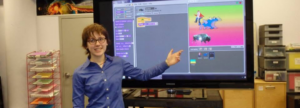
Caroline’s professional journey began in elementary school. While most kids enjoyed playing computer games, she was more interested in building one. In third grade, Caroline enlisted her technology teacher’s help in learning Scratch. She picked it up quickly, creating a dress-up game complete with hand-drawn characters and outfits.
That skill also led her to website design, to help fill a gap in her own life. “There’s an illness I have called complex regional pain syndrome,” she explained. “So, I made a website where people with that disorder could chat and post about their experiences.” The site was popular, drawing users from around the world to connect and share.
Beyond game and website design, Caroline explored many other opportunities that expanded her horizons. She participated in the Braincake program, a precursor to Girls Math and Science Partnership, which allowed her to tour research labs, robotics departments, and even video game companies. “Some of my best memories came from that program,” she reminisced. “It’s how I met one of my most influential mentors.”
While participating in a Braincake event at the Carnegie Science Center (now Kamin Science Center), Caroline met an architect named Nina and shared some of her work with her. Impressed, Nina kept in touch with Caroline and later invited her to teach Scratch at an art and tech community gallery called Assemble in Pittsburgh, PA. Though she didn’t realize it at the time, this invitation was the first step in Caroline’s journey into education.
Becoming Miss Caroline
At 12, Caroline began teaching Scratch programming after school to children at community centers and schools without computer science programs. Many of her students were older than her, a dynamic that took some getting used to.
While teaching these classes, Caroline noticed that many young people, just like her, had valuable, untapped expertise of their own. “So, I created Teens as Teachers, a program where I’d teach kids to teach,” she said. “We would help them develop their curriculum and lesson plans, then they’d go and teach their peers.”
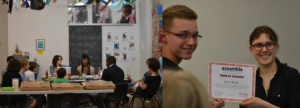
Her teaching experiences weren’t limited to students. Caroline also led professional development sessions for teachers, guiding them on how to integrate technology and STEM concepts into their classrooms.
In high school, Caroline joined Google, where she led workshops for Googlers’ children. “I was a teenager who was friends with adults with startups, it was so cool. I thought I wanted to follow in their footsteps.”
Finding Her Path
After graduating from high school at 16, Caroline pursued a degree in computer science. But after a few months, she realized that the competitive nature of the field wasn’t for her. “I felt overwhelmed and isolated. Studying computer science was nothing like the formative experiences I had in the tech world previously.”
After a semester, she left college to reflect on her path. She realized her true passion wasn’t tech itself, it was teaching tech. Guided by her cousin, a first-grade teacher, Caroline shifted her focus to education. She completed her teacher preparation at Duquesne University, did her fieldwork in Pittsburgh, and discovered her niche: middle school STEM.
A Classroom of Innovation
Today, Caroline teaches robotics and engineering to middle school students, blending her unique childhood experiences in both tech and education to create a dynamic learning space for her students.
Her classroom is a playground for innovation: students build robots for the school’s haunted house, design creative projects that integrate sensors and motors, program fans to change speed or direction based on color input, and so much more. “It’s about giving them freedom to tinker and create while learning core concepts,” she said.
 As for Caroline’s teaching philosophy, it’s simple: every student can contribute something unique.
“We need builders, coders, idea generators, troubleshooters,” she explains. “If a student says, ‘I don’t know what to do,’ I ask them, ‘What do you like to do?’” If they like to read, she might recommend they focus on research. If you like LEGOs, try engineering. “It’s a lesson I first learned during my Mission with Challenger Center. Everyone had their own roles, with completely different skill sets, and we all had to work together to succeed.”
Caroline’s path to STEM education demonstrates how curiosity can grow into a career of purpose. Her story is a testament to the power of experiential learning and a reminder that every STEM adventure has the potential to inspire a lifetime of passion.