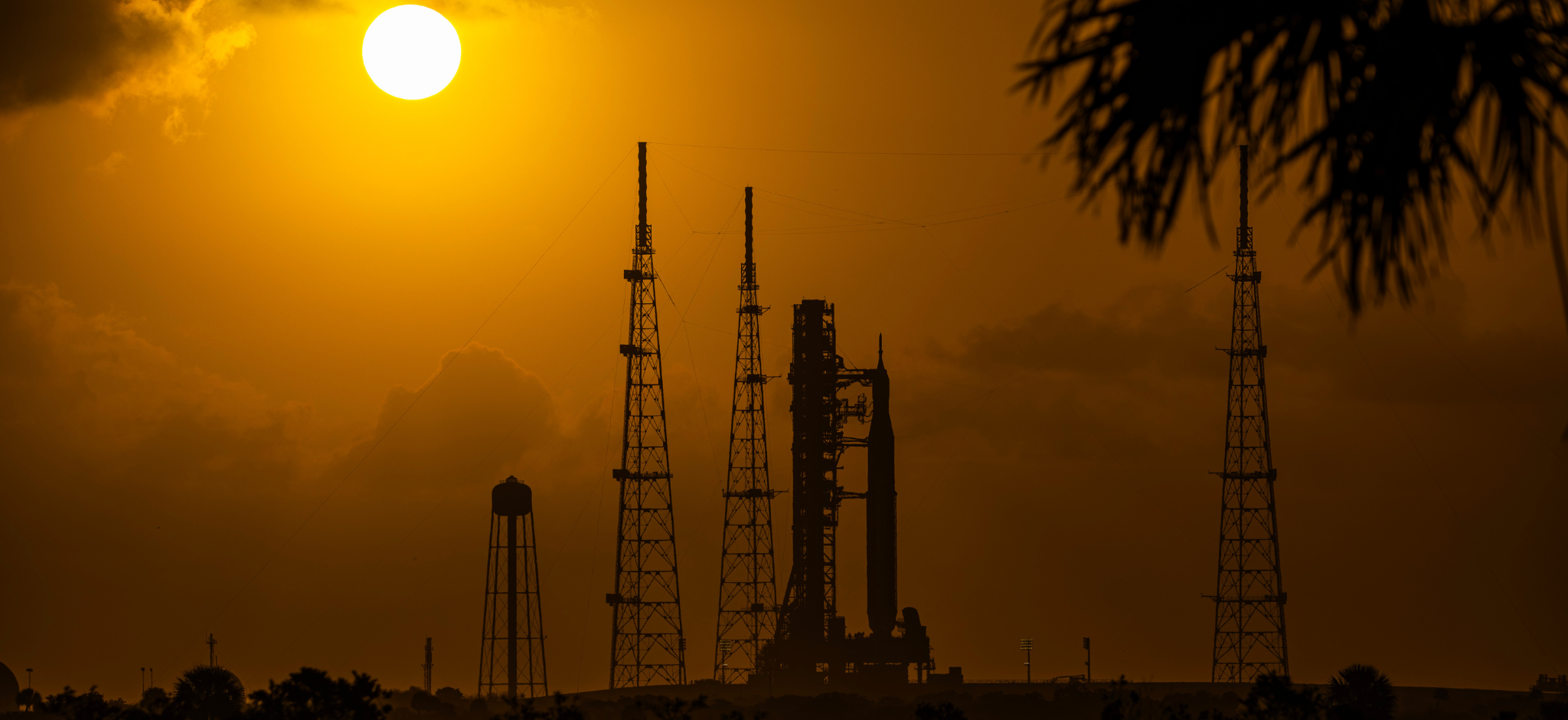
Some places live up to your dreams. Others, like Florida’s Space Coast, completely redefine them
This June, I had the opportunity to visit Space Coast for the first time, joining an incredible group of educators and partners for a behind-the-scenes tour of Kennedy Space Center and Blue Origin’s manufacturing facility. I arrived excited simply to see these iconic places. I left reminded that the future of space exploration isn’t just being built in giant factories or launched from towering rockets—it’s also being nurtured every day in classrooms across the country.
That connection between exploration and education was why I was there.
Each year, Challenger Center partners with the American Institute of Aeronautics and Astronautics (AIAA) to recognize exceptional educators through the Trailblazing STEM Educator Award. These teachers help students experience science. They launch rockets, mentor robotics teams, analyze real NASA data, organize engineering projects, and create opportunities that allow students to see themselves as future explorers and innovators.
Joining us were two of this year’s award recipients, Lillian Reynolds and Kenji Nomura. We also met educators recognized through Blue Origin Club for the Future and Crayola’s Creativity Launches the Future program. Together, they represented classrooms from across the country and every grade level imaginable.
But the one thing everyone had in common was an infectious enthusiasm for inspiring young people.
Jake Williams, Senior Manager of K-12 and Young Professional Programs at AIAA, said, “When you talk to anyone in the aerospace profession, from a first-year engineer to a CEO of a large company, they can tell you about the specific people who supported and motivated them to success. I can’t tell you how many times that person was a teacher. The Trailblazing STEM Educator Award is so important to me because it’s a way to recognize, celebrate, and support those hardworking people who ignite a passion for engineering and empower young people.”
A Visitor Center Unlike Any Other
Our first stop was Kennedy Space Center Visitor Complex.
Calling it a “visitor center” almost feels misleading. Most visitor centers make me think of display cases, brochures, and maybe a guided tour. Kennedy Space Center feels more like a celebration of human curiosity on an unforgettable scale.
The first thing that greeted us was Rocket Garden, where towering rockets rise into the sky like a forest of steel. Walking between them, it’s impossible not to feel both inspired and incredibly small.
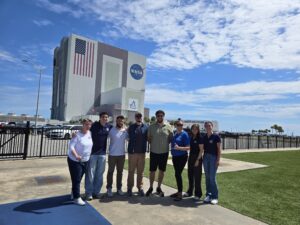 From there, we boarded a bus that took us deeper into Kennedy Space Center. We visited the Gantry, where visitors can examine a rocket booster up close and stand on viewing platforms overlooking active launch areas. We also caught sight of the iconic Vehicle Assembly Building.
Rising abruptly from the otherwise flat landscape, it feels almost impossible in its scale—a massive square monolith where the rockets carrying humanity farther into space begin their journey. Seeing it in person drove home just how ambitious every launch really is.
Standing Face-to-Face with History
One of the most memorable parts of the day was visiting the Space Shuttle Atlantis exhibit.
Before joining Challenger Center, I knew little about the Space Shuttle Program. Walking through the exhibit gave me a new appreciation for the extraordinary challenge NASA undertook after the Apollo missions: creating a landable spacecraft capable of flying to space again and again.
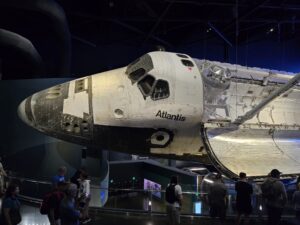 When Atlantis finally appeared, suspended before us, I unexpectedly found myself tearing up. It’s difficult to explain the feeling: Part engineering marvel. Part work of art. Part symbol of decades of determination, collaboration, and hope.
The exhibit also balances that sense of awe with moments of pure fun. Families explored an International Space Station-themed play area, kids raced down giant slides, and exhibits answered the kinds of questions every student loves to ask—like how astronauts eat in space and, of course, how they use the bathroom.
There was also a deeply moving memorial honoring the crews of Challenger and Columbia. Rather than focusing only on their accomplishments as astronauts, the memorial shared pieces of their lives, personalities, and passions. It reminded me that these explorers were regular people who dared to dream extraordinary dreams.
Even after an entire day, it felt like we had only scratched the surface. Between climbing into a Blue Origin capsule simulator, trying a virtual reality moon mining experience (where I briefly held the highest score in our group!), and countless exhibits we barely had time to explore, I could have happily spent several more days there.
Watching the Morning Sky Come Alive
The next morning began before sunrise.
Word had spread that we would be able to watch a Falcon 9 launch from the beach outside our hotel. By 6:40 a.m., people were already gathering along Cocoa Beach, eyes fixed on the horizon.
When that bright point of light finally appeared, and the engines carried the rocket skyward, I grinned from ear to ear. Thanks to the educators standing beside me, I learned to recognize the staging events as the rocket climbed higher. A few moments later came the deep, rolling sound—delayed just long enough to remind us of the immense distance involved.
Watching something quite literally break free from Earth’s gravity has a way of putting everyday life into perspective.
Learning Through Play
Later that morning, we met with the team from Blue Origin’s Club for the Future, the company’s nonprofit dedicated to inspiring future generations to pursue careers in STEM while benefiting life here on Earth.
Instead of simply telling us about engineering, they challenged us to become engineers ourselves. Working in small teams with cardboard, popsicle sticks, tape, scissors, and a fictional budget, we designed machines capable of clearing “space debris” scattered across the floor.
The debris happened to be paper, pencils, and stickers—but the engineering challenge felt surprisingly real. For a few hours, we experienced exactly the kind of collaborative, creative problem-solving that great teachers bring into their classrooms every day.
“What’s amazing about an activity like this is how it levels the playing field,” said Heather Nelson, director of Club for the Future. “For a moment, we all became designers and problem-solvers, completely absorbed in the challenge. It’s a perfect reminder that you don’t need a million-dollar lab to teach the core principles of engineering—you just need a compelling problem, a few simple materials, and the freedom to get creative.”
Where Rockets Become Reality
Our final stop was Blue Origin’s manufacturing facility.
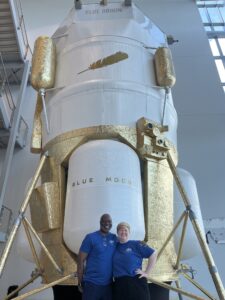 The lobby alone was impressive, filled with models of Blue Moon, New Glenn, and the company’s rocket engines. But the real highlight came after putting on safety glasses and stepping onto the manufacturing floor.
There, we watched engineers transform massive aluminum panels into remarkably lightweight rocket components by carving intricate honeycomb structures into solid metal. We followed those pieces through welding, inspection, cleaning, transport, and assembly as they gradually became sections of New Glenn.
What struck me wasn’t just the technology. It was the craftsmanship.
Every weld, every measurement, every inspection reflected an incredible level of care. When you’re building a rocket taller than the Stateu of Liberty every detail matters.
Seeing that process up close made one thing abundantly clear: Going to the Moon—or beyond—is no small feat.
The Real Launch Pad
As remarkable as the rockets were, it was the educators who were the most inspiring.
Throughout the week, conversations naturally turned toward classrooms rather than careers. At dinner, teacher after teacher shared stories about mentoring new educators, launching new STEM programs, creating opportunities for underserved students, and eagerly exchanging lesson ideas with one another.
These are people who genuinely love what they do.
Experiences like this aren’t simply rewards for outstanding educators, although they certainly deserve recognition. They’re investments.
When teachers see a rocket launch with their own eyes, walk through the facilities where spacecraft are built, and collaborate with engineers and fellow educators, they return home carrying something impossible to package in a curriculum guide: genuine excitement.
That excitement is contagious.
It finds its way into classrooms, into conversations with students, into after-school clubs, science fairs, engineering competitions, and moments of curiosity that can shape a child’s future.
Standing on the Space Coast, watching rockets rise into the morning sky, I was reminded that the future doesn’t begin at launch. It begins long before that—in classrooms where passionate teachers help students believe that reaching for the stars is something they can do, too.

Keep Reading
We think you may like these.