Blogs | 8.13.2026
The Space Story Hidden in a High School Hallway
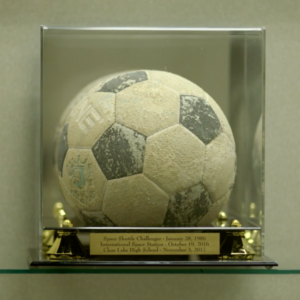 “Space Shuttle Challenger – January 28, 1986
International Space Station – October 19, 2016
Clear Lake High School – November 3, 2017”
That’s the inscription underneath a soccer ball sitting in a trophy case at Clear Lake High School in Houston, Texas. At first glance, it’s an unusual combination of places and dates. How does a high school team’s practice soccer ball end up on the International Space Station? The answer is less about any of the places the ball traveled and more about what it came to represent.
“Space Shuttle Challenger – January 28, 1986”
As the closest high school to NASA’s Johnson Space Center, the Clear Lake Falcons have no shortage of interesting connections to the space program. It’s not unusual for most of the students in a classroom to have parents who work as engineers, scientists, or astronauts. That was also the case in 1986 when Janelle Onizuka was a student and a member of the Lady Falcons Soccer Team. Her father Ellison Onizuka was a NASA astronaut and, proudly, the Lady Falcons assistant soccer coach.
In January of 1986, the girls on the soccer team signed an old practice soccer ball, writing their names and messages of support for the crew of the Space Shuttle Challenger. It became a way for the girls to participate in the mission, sending a small piece of the community up with the astronauts. The ball was loaded aboard the shuttle as one of Ellison Onizuka’s personal items.
On January 28, 1986, Challenger launched on mission STS-51-L. Seventy-three seconds after liftoff, the shuttle was lost, along with all seven members of its crew: Francis “Dick” Scobee, Michael Smith, Ronald McNair, Judith Resnik, Gregory Jarvis, Christa McAuliffe, and Ellison Onizuka. In the aftermath of the accident, the United States Coast Guard recovered pieces of the shuttle and personal items from the debris. Among those items was the soccer ball.
The ball was gifted back to Clear Lake High School by the Onizuka family and placed in a trophy case opposite the main office. For decades, students and teachers walked past it every day. As new accomplishments filled the display cases around it, the worn soccer ball became easier to overlook. The signatures faded. The ball aged. Without context, it could have appeared to be just another old piece of school history.
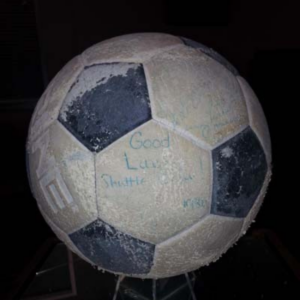
The faint “Good Luck, Shuttle Crew!” message became one of the ball’s last connections to the students who signed it, the astronaut who carried it, and the mission that changed so many lives.
Fortunately, in a community where space exploration is so woven into everyday life, the story of the soccer ball would not be lost.
“International Space Station – October 19, 2016”
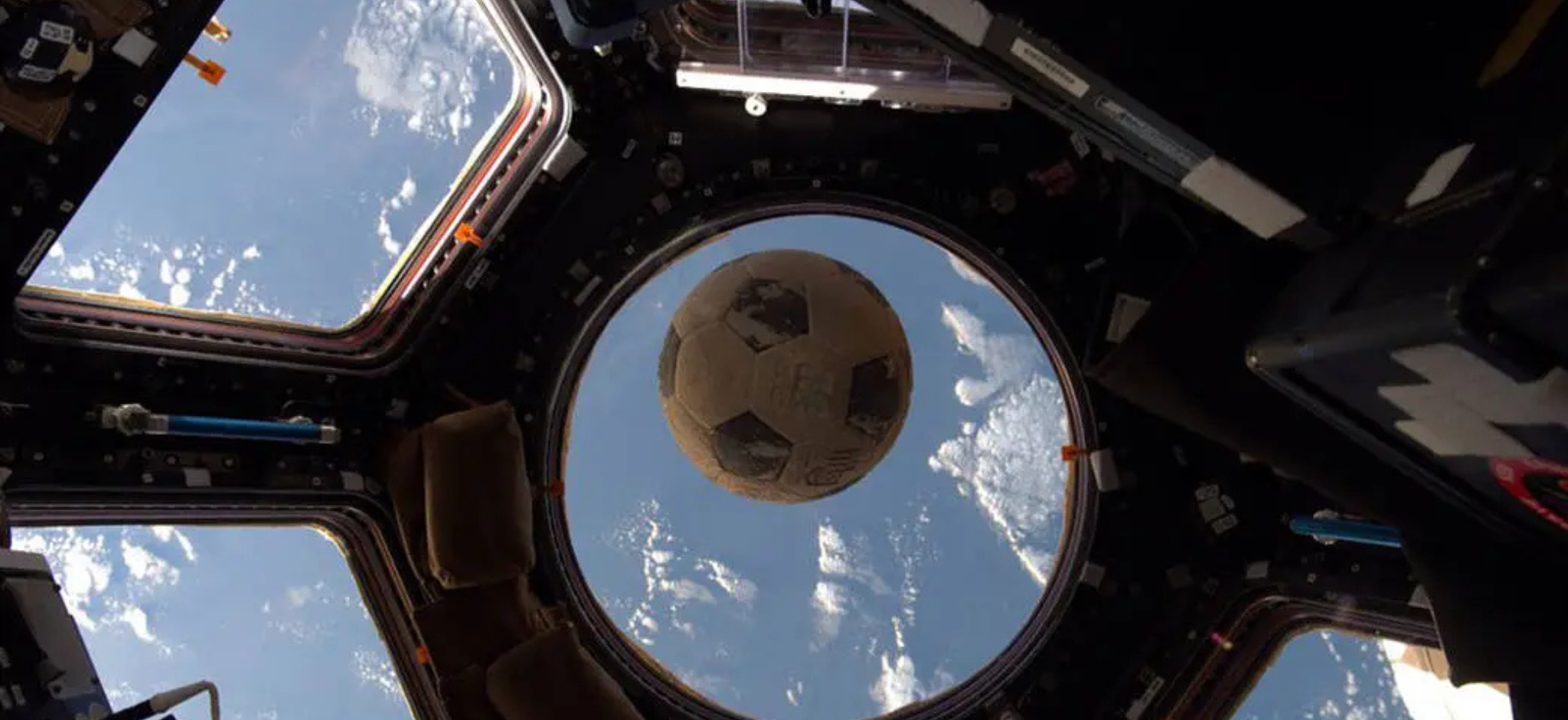
Thirty years after Challenger, the soccer ball began another chapter. Col. Shane Kimbrough, an astronaut preparing for a mission aboard the International Space Station and the parent of another Clear Lake High School student, learned the ball’s story and offered to bring it to orbit. On October 19, 2016, the ball launched to the ISS, finally completing a journey that it began three decades earlier.
The soccer ball spent 173 days in space, orbiting the Earth nearly 3,000 times, and returning on April 10, 2017.
“Clear Lake High School – November 3, 2017”
After returning to Earth, the soccer ball came back to where its story began. On November 3, 2017, it was returned to Clear Lake High School and placed in a new display case near the front entrance, where thousands of students could see it each day.
A few years later, I became one of those students.
I attended Clear Lake High School and walked past that soccer ball in the hallway every day. When I learned the story behind it, it struck a chord—I played soccer for the same team as those girls whose faded signatures were still on the ball 40 years later.

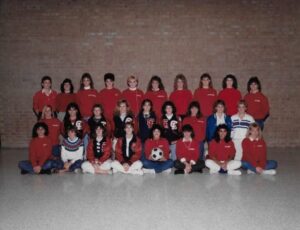
The Clear Lake High School Lady Falcons from 2020 and 1986.
I spent my whole life living a few miles away from NASA’s Johnson Space Center, but the most impactful and tangible connection I felt toward someone who went to space was a tattered soccer ball that sat on a shelf at my high school. That’s not meant to discount the incredible experience of growing up surrounded by the achievements of our space program, but this felt more personal. While space travel can feel like such an enormous endeavor, it is also one that is undertaken by fathers and daughters and assistant soccer coaches, whose stories as individual people extend far beyond a name on a mission patch.
That’s what makes the Challenger crew’s legacy so enduring. Space exploration is often viewed through the lens of spacecraft, technology, and scientific achievement, but at its core, it has always been about people. It is about ordinary people that become extraordinary: a teacher in a classroom, a parent at a soccer game, an astronaut carrying a signed ball into orbit.
The soccer ball’s long and winding journey from a high school’s practice field to the International Space Station is a reminder that the impact of exploration does not end when a mission ends. It continues through the stories we carry forward and through all of the people, like me, who are inspired by them.
Keep Reading
We think you may like these.
Blogs
Challenger Learning Center of the Twin Tier Region Named Arthur C. Clarke Innovation Award Winner
Challenger Learning Center of the Twin Tier Region Named Arthur C. Clarke Innovation Award Winner
Challenger Learning Center of the Twin Tier Region Named Arthur C. Clarke Innovation Award Winner
...
Read More
