Manufacturing Systems Engineer, Northrop Grumman
Building Satellites and Mentoring Women in STEM
Buehler Challenger & Science Center
At nine years old, Nina Arcot spent her summer writing postcards from distant planets and decorating space-themed cookies. Those joyful summer days were the start of a journey that would one day lead her to building satellites for Northrop Grumman. Today, as a Principal Manufacturing Systems Engineer working on cutting-edge space systems, Nina’s story reminds us what can happen when young curiosity meets hands-on STEM experiences and mentors who believe in the next generation.
Blasting Off from Challenger Center
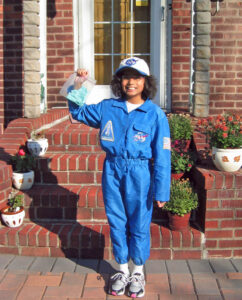 Nina’s connection to Challenger Center began in 2007 at Buehler Challenger and Science Center, where she attended Astronaut Rookie Camp the summer before fourth grade. Her family already knew the Center from when her older brother had participated in a simulated mission years earlier through his school. When Nina began expressing an interest in space in early elementary school, her parents knew exactly where to take her.
“I was so excited to spend a few days literally just doing space stuff,” Nina recalled. She loved reading about space, but Challenger Center was the first place where she could spend entire days immersed in it. The experience made science tangible and memorable, transforming a childhood interest into something she could actively explore.
That first camp wasn’t the last. Nina returned to the Center every summer, eventually participating in nearly every camp offered. As she grew older, her role evolved from camper to volunteer junior commander during high school. She also attended public Missions at other Challenger Learning Centers and special events, including an ice cream social where she met astronaut Barbara Morgan.
Connecting Passion to Profession
For Nina, interest in space was always there, but her path wasn’t perfectly linear. In high school, she became deeply interested in chemistry and considered majoring in chemistry or chemical engineering. It wasn’t until she was preparing for college that everything clicked. As she compared course paths, mechanical and aerospace engineering stood out as a way to combine her long-standing love of space with hands-on problem solving.
Nina recalled that “seeing all the different applications of satellites and how they impact everyday life” made her dreams of space feel attainable. A visit to campus—and a conversation with the college’s rocketry club—sealed the deal.
“It felt similar to Challenger Center’s camps,” she said. “You can do space stuff all day, every day. That could actually be what I’m doing in school and beyond.”
Today, Nina works in satellite manufacturing at Northrop Grumman, helping bring complex space systems to life. She figures out how to build satellites efficiently and at scale, from ensuring the right equipment and staffing are in place to developing new manufacturing processes. As industry demand for satellites increases, her role focuses on speed, efficiency, and risk mitigation. She’s also involved in shaping a new manufacturing facility, exploring digital transformation tools like augmented reality and asset tracking to make production smarter and faster.
A Mentoring Mentality
But Nina’s impact doesn’t stop at her day job. Giving back has been a consistent thread throughout her life—one that started when she volunteered as a junior commander at Buehler Challenger and Science Center. “We couldn’t have had the experience we did without those volunteers,” she said. “As I got older, I wanted to give back to the kids going to camp after me.”
That mindset carried into college, where she led outreach efforts for her rocketry club, and into her professional career. Nina is deeply involved with the Brooke Owens Fellowship, an organization that supports undergraduate women and gender minorities pursuing aerospace careers. Since becoming a fellow in 2020, she has served as an alumni mentor and helped select new classes of fellows each year. Nina now leads the mentorship program, pairing students with both alumni and executive mentors across the industry.
She’s also active in the Society of Women Engineers, volunteering with the Early Career Professionals Affinity Group. There, she helps organize events focused on professional development and community building for engineers in the first decade of their careers.
For Nina, mentorship—formal and informal—is essential. She credits older students, club leaders, and peers who shared knowledge and made space for others as she was coming up. “No matter where you are, you can be a mentor to someone,” she said. Even early in her career, she was surprised to realize that younger students already saw her as someone to learn from.
Keep Learning and Keep Doing
When asked what advice she’d give to a middle school student interested in space, Nina’s response was simple and encouraging: learn as much as you can. “We’re in a really exciting time for space,” she said. With so many missions and career paths, she encourages students to explore widely, then focus on what excites them most.
She’s especially passionate about hands-on STEM experiences—like those at Challenger Center. Doing, she believes, makes learning more exciting, more memorable, and more meaningful. And hands-on work is key to learning to solve problems. “Problem-solving is probably the most important thing I learned in college. It’s not like I’m using differential equations in my daily work,” Nina laughed. “But I’m always assessing different solutions and figuring out a path forward.”
Just as important is teamwork. “There’s literally no role you can do independently on a Challenger Mission,” Nina said. That lesson mirrors the real world of STEM careers, where collaboration and communication are critical to success.
From a nine-year-old space camper to a leader helping build the satellites of tomorrow, Nina Arcot’s journey shows what’s possible when we invest in young people early. By fostering curiosity, providing hands-on experiences, and surrounding students with mentors who lift them up, we don’t just inspire future STEM leaders—we help launch them.