Blogs | 10.19.2026
How Hands-On Learning Changed One Educator’s Career
When Joshua Sneideman first stepped into a middle school classroom, he had a passion for science and a desire to inspire young minds. What he didn’t yet have was the experience or the tools to turn that passion into effective teaching.
“I was horrible,” Josh recalls of his first year as an educator.
A trained geologist, Josh had always wanted to teach. But managing a class full of middle schoolers and designing engaging lessons proved more difficult than he expected. At the end of his rope, he followed his mentor’s suggestion to visit the Christa McAuliffe Challenger Learning Center at Framingham State University for professional development.
That experience would change the trajectory of his career.
Learning to Let Students Lead
In 2003, Josh took every training course the Center offered that summer. He learned to use hands-on science activities that asked students to conduct experiments, collect and analyze data, and develop their own interpretations of what they observations.
He returned to his classroom with a new approach. Instead of positioning himself at the front of the room as the source of knowledge, he learned to guide students as they got their hands dirty and directed their own learning.
The difference was profound. Yes, the chaos was still there, but it was a productive chaos. “I became the guide on the side,” he says. “And that created the space for the kids to do the work, think about the work, talk about the work, come to their own conclusions.”
Josh noticed that meaningful learning happens when students actively engage with ideas and experiences, rather than simply listening to explanations or memorizing information. They build understanding by testing their ideas, interpreting evidence, and making connections.
That approach also changes how students see themselves. When they can draw their own conclusions from evidence, they learn to trust their ability to think critically and solve problems.
Going Deeper, Making Connections
 Josh brought the principles he learned at Challenger Center into classrooms in Massachusetts, Trinidad and Tobago, Costa Rica, and California. His teaching philosophy continued to evolve as he earned a master’s degree in education—once again at Framingham State University. As Josh explored deeper into how students learn, one principle became especially important: depth matters more than breadth.
He recalls teaching density, a concept that many curricula might cover in a day or two. He spent two months exploring it with his students, using displacement experiments and examining why things float or sink, as well as how density influences the atmosphere and oceans. His goal wasn’t simply to help students remember a definition. It was to help them understand the concept well enough to recognize it in different contexts and apply it to new problems.
He took a similar approach to student choice. When students asked how they would demonstrate their learning, Josh sometimes turned the question back to them: How did they want to learn the material, and how could they show what they understood? With clear expectations and learning objectives, students could choose how to present their knowledge while still meeting high standards.
This kind of learning makes room for curiosity, creativity, and individual strengths. It also helps students connect science and mathematics to the world around them, building understanding that extends beyond a test or a single lesson.
From Classroom Learning to Real-World Possibilities
 Today, Josh continues to put these principles into practice by helping expand access to STEM education and career exploration. He has helped grow Learning Blade, a resource that introduces middle school students to STEM careers through real-world challenges. He also works on Ready for Industry, which helps high school students explore career pathways and what it takes to work in different industries.
Across these efforts, students encounter problems that professionals actually work to solve, from improving medical care to designing more efficient ways to deliver resources after natural disasters. Going beyond what STEM professionals do and demonstrating how their work affects people and communities further deepens the relevance of these careers to students.
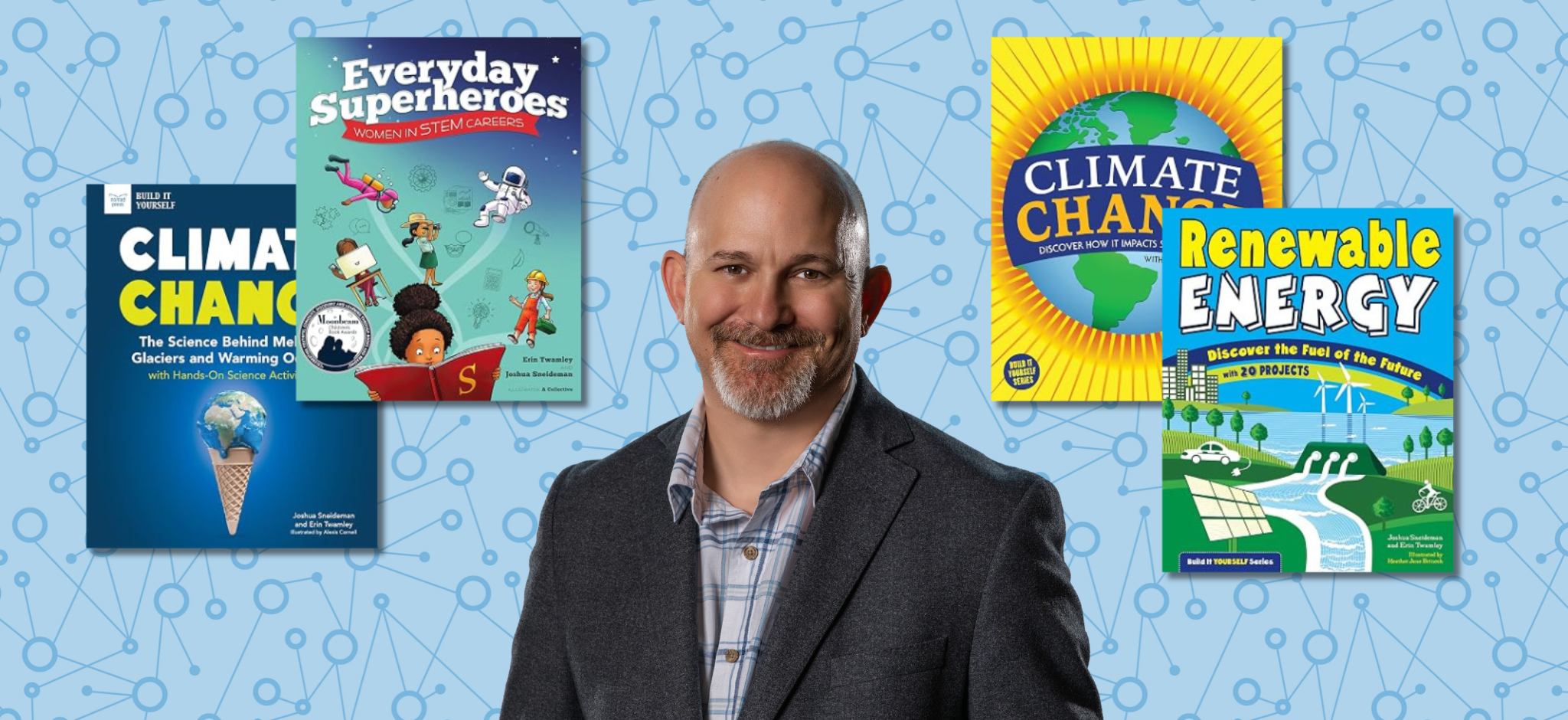
Josh has also written books for educators and middle-grade readers that pair topics such as climate change and renewable energy with hands-on lessons and projects. Across his work, the goal remains consistent: help students build understanding through experience and see how science connects to their lives.
Looking back, Josh isn’t sure he would have stayed in education without the training he received at a Challenger Learning Center. His first year in the classroom had been difficult, but the experience helped him discover a way to teach that worked for him and his students.
“If I had my vote, every teacher on the planet would do Challenger Center professional development prior to entering a classroom,” he says.
For Josh, that experience was more than a collection of teaching techniques. It gave him a framework for helping students discover what they can do for themselves.
And that lesson continues to shape his work today: when students have opportunities to investigate, experiment, solve meaningful problems, and make discoveries of their own, STEM becomes more than a subject to study. It becomes something they can understand, use, and imagine themselves being part of.
Keep Reading
We think you may like these.
Blogs
Challenger Learning Center of the Twin Tier Region Named Arthur C. Clarke Innovation Award Winner
Challenger Learning Center of the Twin Tier Region Named Arthur C. Clarke Innovation Award Winner
Challenger Learning Center of the Twin Tier Region Named Arthur C. Clarke Innovation Award Winner
...
Read More
