Deputy Director, Washington NASA Space Grant Consortium
STEM Is Bigger Than a Job Title
John Fluke Jr. Challenger Learning Center at the Museum of Flight
When Kam Yee was a young college student, she thought she knew exactly what her future would look like. She loved space. She loved science. She was an avid member of her school’s rocketry club. Naturally, she planned to become an engineer.
But the path wasn’t as straightforward as she imagined.
As a woman of color studying engineering in the early 2000s, Kam often felt isolated. Group projects were difficult. Making connections with classmates was harder than it should have been. While she remained passionate about aerospace, she began to wonder whether she truly belonged in the field.
Fortunately, she had a network reminding her that she did.
Finding a Place in Space
While attending college, Kam worked as an educator at the Challenger Learning Center at Seattle’s Museum of Flight. There, she spent her days guiding students through simulated space missions, learning about NASA programs, and sharing her excitement about exploration with young people.
 “I was rattling off NASA facts and explaining space missions to kids,” she recalls. “It was really reaffirming for me to know there is a place for me in aerospace.”
Like many students, Kam had equated STEM with a specific job title. If she wasn’t going to become an engineer, she worried that she might be leaving STEM behind altogether.
Instead, she discovered something important: STEM is much bigger than any single career.
Following Curiosity, Not Titles
Her interests eventually led her to study environmental science, where she became fascinated by questions that connected sustainability and space exploration. How would humans live responsibly on Mars? How would future settlements recycle water, manage waste, and use resources efficiently? The questions were different, but the curiosity that drove them was the same.

Today, Kam serves as Deputy Director of the Washington NASA Space Grant Consortium, helping connect students, educators, colleges, and industry partners across the state. Her career still centers on space and STEM, even though it looks very different from the path she originally imagined.
Looking back, she wishes she could tell her younger self to think bigger than just a job or a degree.
“Your dream is not tied to a job title or a company you work for,” she says. “[I’d tell my younger self to] just imagine you can chase your interests and your spark, no matter what the title is.”
That message is especially important for students today.
For generations, young people interested in space were often given a simple formula: study math and science, go to college, become an engineer or astronaut. While those careers remain important, today’s STEM workforce is far broader. It includes educators, technicians, communicators, project managers, data analysts, machinists, sustainability experts, and countless other tradespeople and professionals whose work helps advance science and exploration.
Kam believes students should focus less on specific titles and more on the skills they are developing.
“STEM skills are critical thinking. Being okay with trial and error. Teamwork. Communication. Systems thinking,” she explains. “Those are STEM skills. They’re not tied to a specific project.”
Those skills can open doors in ways students may never expect.
The Long Way Can Be the Right Way
Kam’s own journey took eight years to complete her undergraduate degree. Along the way, she became a parent, changed academic paths, worked in education, earned a graduate degree in space studies, and built a career that blends her passion for space with her commitment to helping others succeed.
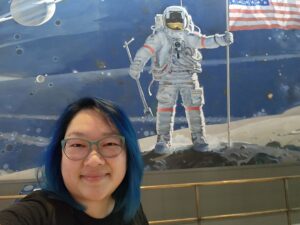 “It took a long, winding path,” she chuckles, remembering. “But I’m really glad where I landed.
None of her journey followed the plan she had imagined as a teenager. And that’s exactly the point.
At Challenger Learning Centers across the country, students participate in hands-on missions that encourage collaboration, problem-solving, communication, and resilience. The goal isn’t simply to prepare the next generation of astronauts or engineers. It’s to help young people discover that they belong in STEM—and that there are many ways to contribute.
For Kam, that sense of belonging made all the difference.
Today, as she works to support the next generation of STEM learners, she carries forward the message that STEM isn’t about fitting yourself into a predetermined role. It’s about finding where your curiosity, talents, and passions can make an impact.
And sometimes, the most rewarding destination is one you never planned to reach.
