Press Releases | 7.22.2026
Challenger Center and Blue Origin’s Club for the Future Launch Updated Destination Moon Virtual Mission with Real Spaceflight Footage and Experts
Real-world spaceflight footage, Blue Origin experts, and lunar exploration challenges bring the future of Moon exploration into classrooms and learning environments
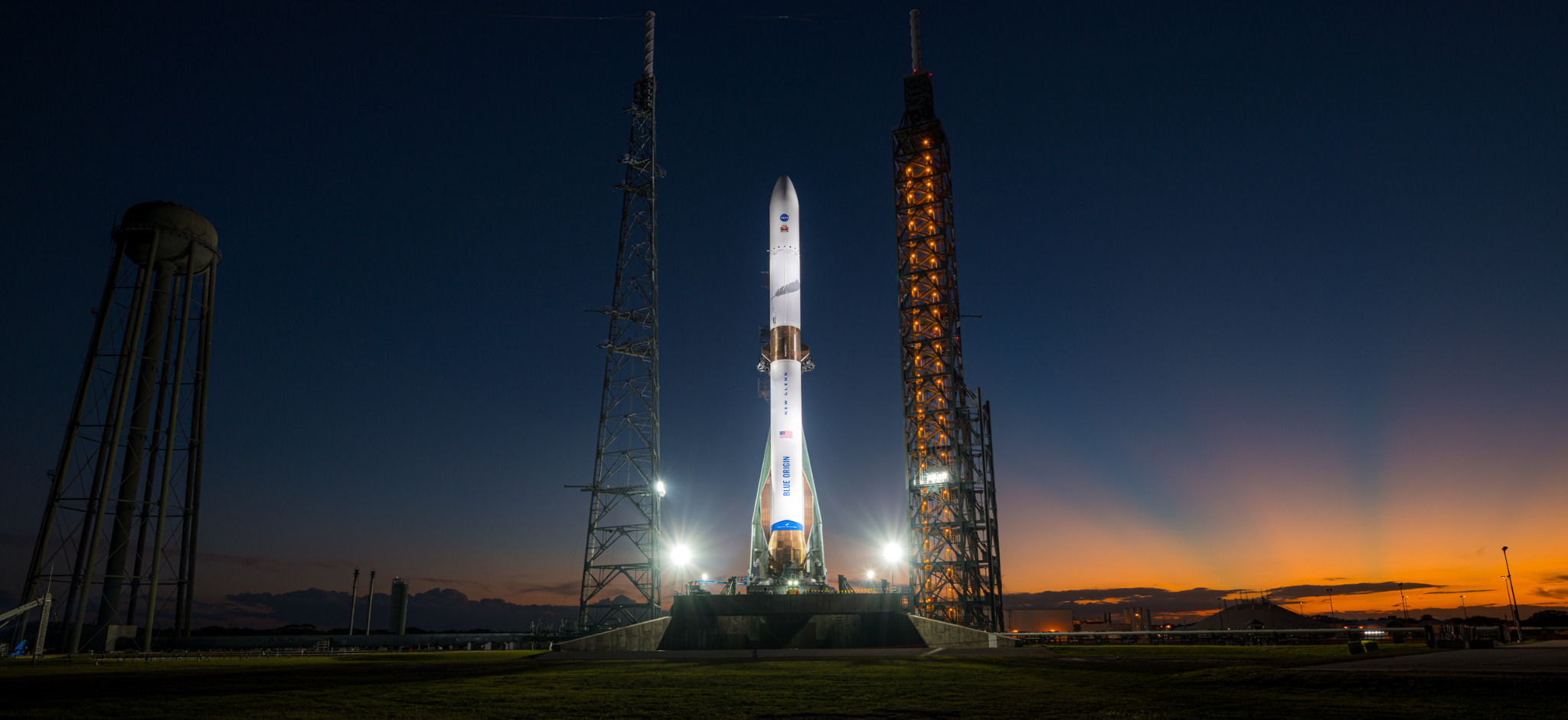
WASHINGTON, D.C. — Challenger Center and Blue Origin’s Club for the Future today launched a major update to Destination Moon, their popular virtual mission, now featuring actual launch footage of the New Glenn rocket and direct mentorship from Blue Origin subject matter experts. The immersive learning experience, designed for students in grades 5–8, puts them at the heart of a simulated lunar mission using the latest in commercial spaceflight technology.
 Originally developed with support from Blue Origin’s Club for the Future, the program has been refreshed to connect students with the realities of modern space exploration. In the mission, student teams work together to launch New Glenn, land the Blue Moon lander, and identify a potential site for a future lunar outpost.
The mission can be experienced in classrooms, afterschool programs, camps, clubs, and other learning environments where students have access to a computer and internet connection.
“The space industry is evolving rapidly, and we want students to see themselves as part of that future,” said Mike Kincaid, President and Executive Director of Challenger Center. “This updated experience gives young people the opportunity to engage with authentic challenges inspired by real lunar exploration efforts while introducing them to the diverse careers that make space missions possible.”

Significant updates include actual New Glenn launch footage, replacing the concept renderings used in earlier versions of the mission, as well as new high-resolution graphics of Blue Moon that reflect the latest design advancements of the lunar lander. A major addition to the updated program is the inclusion of video introductions and guidance from Blue Origin professionals whose real-world jobs closely align with the mission tasks students perform.
The mission is now guided by Tabitha Lipkin, Senior Content Producer at Blue Origin and an accomplished science journalist. Through a series of recorded videos, Lipkin introduces students to the mission’s objectives and helps them understand the significance of lunar exploration and future habitation efforts on the Moon.
Students on the Engines Team are mentored by Rebecca Landrau, Risk Manager, who guides them through engine testing, launch procedures, and Blue Moon’s descent to the lunar surface. Chelsea Stalcup, Module Lead Project Manager, introduces the Tracking Team to monitoring solar activity, evaluating payload trajectories, and ensuring safe passage through space. Sean Wright, Range Coordinator, helps the Mapping Team analyze coordinates and identify optimal lunar landing locations. Luis Chavez Navarrete, Integrations Engineer, works with the Structure Team as they conduct vehicle checks, launch payloads, and verify mission systems.
By featuring a variety of professionals, the program highlights the many possible careers involved in space exploration and demonstrates how collaboration across disciplines makes ambitious missions possible.

“Inspiring the next generation to build a future of life and work in space for the benefit of Earth is at the core of our mission,” said Heather Nelson, Director of Club for the Future. “By integrating real New Glenn footage and our incredible team members into the Destination Moon challenge, we close the gap between the classroom and the launch pad so students understand that the careers of tomorrow are being built today, and there is a place for them on this journey.”
The updated mission aligns with the growing momentum of NASA’s Artemis program. Blue Origin’s Blue Moon is slated to serve as the Human Landing System for Artemis V, which will be launched by the heavy-lift New Glenn rocket.
Destination Moon is one of three Satellite Challenges offered by Challenger Center, alongside Observation Earth and Destination Mars. Together, these virtual missions engage students in collaborative problem-solving, critical thinking, communication, and STEM learning through realistic spaceflight scenarios.
To learn more about Destination Moon and Challenger Center’s Satellite Challenges, visit Challenger Center’s website.
About Challenger Center
Challenger Center is a leading nonprofit STEM education organization that has inspired over 6.5 million students through hands-on learning experiences. Through its network of Challenger Learning Centers and virtual programs, Challenger Center engages students in collaborative, real-world challenges that build STEM knowledge and essential skills for future success. Challenger Center was created by the Challenger families to honor the crew of shuttle flight STS-51-L.
About Blue Origin’s Club for the Future
Founded by Blue Origin, Club for the Future is a nonprofit with the mission to inspire and mobilize future generations to pursue careers in STEAM (science, technology, engineering, arts, and math) for the benefit of Earth. The Club and its partners are doing this through the Access to Space programs, providing space-focused lessons and events, and activating ambassadors around the world. To date, Club for the Future has engaged with millions of individuals through our programs, initiatives, and collaborations.
Keep Reading
We think you may like these.
Blogs
Challenger Learning Center of the Twin Tier Region Named Arthur C. Clarke Innovation Award Winner
Challenger Learning Center of the Twin Tier Region Named Arthur C. Clarke Innovation Award Winner
Challenger Learning Center of the Twin Tier Region Named Arthur C. Clarke Innovation Award Winner
...
Read More
